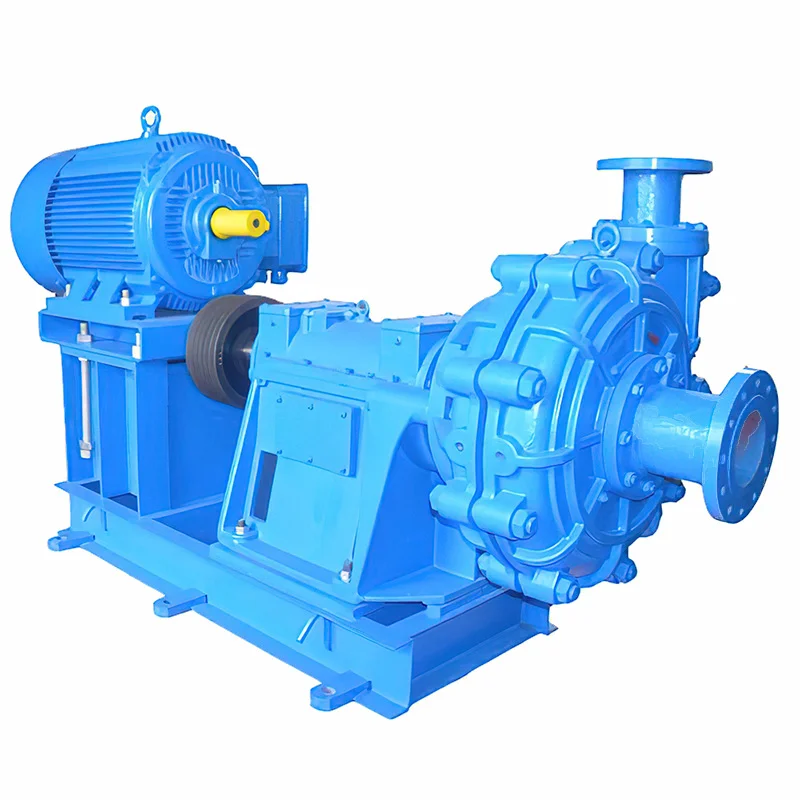
Heavy Duty Slurry Pump Factory for Mining and Metallurgy
Managing the transport of high-density abrasive slurries requires more than just basic pumping power; it demands a strategic balance between material hardness and hydraulic efficiency. For mineral processing plants and metallurgy operations, the failure of a pump often results in costly unplanned downtime and significant productivity loss. The HAH series Heavy Duty Slurry Pumps are engineered to address these specific industrial pain points, providing a robust solution for transporting dense solids through hydrocyclone feeds, flotation cells, and tailings management systems.
By integrating a horizontal double-casing axial suction centrifugal design with a ductile iron fully lined casing, these units ensure that the most abrasive particles are managed without compromising the structural integrity of the pump. Whether the application demands the extreme wear resistance of high chrome alloys or the corrosive protection of rubber linings, these pumps offer the flexibility needed to maintain operational stability in the world's most demanding industrial environments.

Engineering Excellence in Abrasive Fluid Transport and Hydraulic Stability
The HAH series is defined by its ability to handle high-concentration abrasive slurries without the rapid degradation common in standard centrifugal pumps. The core of its durability lies in the ductile iron fully lined casing, which provides an exceptional strength-to-weight ratio and ensures safety even under high-pressure conditions. This design choice significantly extends the service life of the equipment, reducing the frequency of liner replacements and lowering the total cost of ownership for plant operators.
From a technical perspective, the axial suction centrifugal architecture is optimized for fluid dynamics that minimize turbulence and internal wear. This is critical when transporting dense slurries where particles can act as grinding media against the pump's internal surfaces. By optimizing the flow path, the HAH series achieves a balance between high flow rates (up to 30,000 m³/h) and sufficient head pressure to overcome pipeline friction in large-scale mining installations.
- Precision Castings: Utilizing advanced furan resin sand production lines for superior surface finish and dimensional accuracy.
- Material Versatility: Wetted ends can be customized with high chrome alloys for sharp particles or rubber for softer, corrosive media.
- Pressure Optimization: The HH variant specifically targets high-density applications requiring superior discharge pressure.

Material Selection Strategies for Maximum Wear Resistance
One of the most critical decisions in slurry handling is the selection of lining materials. The HAH series offers fully interchangeable metal and rubber linings, allowing engineers to adapt the pump to changing slurry characteristics without replacing the entire unit. For applications involving sharp, highly abrasive mineral particles, high chrome alloy is the gold standard, providing an extremely hard surface that resists cutting and gouging wear.
Conversely, in scenarios where the slurry is softer but potentially corrosive, rubber lining is recommended. Rubber provides excellent resilience and chemical resistance, absorbing the impact of particles rather than resisting them through hardness alone. This versatility ensures that the pump remains efficient whether it is operating in a gold mine, a coal power plant, or a sewage treatment facility. The ability to switch between these materials means the equipment can evolve alongside the plant's operational needs.
To guarantee the quality of these materials, every component undergoes rigorous testing. Using direct-reading spectrometers and inner hardness testers, the metallurgical composition is verified for 100% traceability. This ensures that the "high-grade, precision, and advanced" positioning of the product is backed by empirical data and international quality standards such as ISO 9001.
Optimizing Plant Layout with Flexible Installation and Maintenance
Industrial piping layouts are often constrained by existing infrastructure, making traditional pump installation a challenge. The HAH series solves this through a flexible outlet design, allowing the discharge position to be set in eight different directions at 45° intervals. This capability allows engineers to optimize the piping path, reducing the number of elbows and bends in the line, which in turn lowers friction loss and decreases the overall energy consumption of the pumping system.
Maintenance efficiency is equally prioritized to minimize unplanned downtime. The pump offers both grease and oil lubrication options, catering to different environmental preferences and maintenance schedules. Grease lubrication is often preferred for its simplicity and reduced leak risk, while oil lubrication provides superior cooling and bearing longevity in continuous, high-load operations.
Furthermore, the inclusion of simplified inspection ports allows for proactive wear monitoring. Instead of dismantling the pump to check liner thickness, operators can perform targeted inspections to optimize replacement cycles. This transition from reactive to predictive maintenance is essential for maintaining the stability of critical-path processes like tailings management and hydrocyclone feeding.
Heavy Duty Pump Performance and Selection Matrix
| Performance Indicator | Standard Centrifugal Pump | HAH Heavy Duty Pump | HH High-Pressure Variant | Operational Impact |
|---|---|---|---|---|
| Wear Life Expectancy | Low (Frequent Changes) | High (Chrome/Rubber) | Very High (Reinforced) | Reduced Downtime |
| Slurry Concentration | Limited to Thin Slurries | Optimized for Dense | Maximum Density | Higher Throughput |
| Installation Flexibility | Fixed Outlet | 8-Way Outlet (45°) | 8-Way Outlet (45°) | Lower Piping Cost |
| Pressure Capability | Standard/Low | Medium to High | Ultra-High Pressure | Better Reach/Head |
| TCO (Total Cost) | Higher (Replacements) | Lower (Lifecycle) | Lowest (Durability) | Improved ROI |
Manufacturing Capabilities and Quality Assurance Framework
The reliability of a slurry pump is a direct result of its manufacturing precision. Our production base utilizes a whole-chain precise processing system, starting from a 10t/h furan resin sand production line and intermediate frequency induction electric furnaces. By controlling the entire process—from casting forming to final machine assembly—we eliminate the variability associated with third-party casting, ensuring that every impeller and volute meets strict geometric tolerances.
Precision machining is executed through a suite of high-end equipment, including horizontal and vertical lathes, boring machines, and drilling machines. To ensure the heat treatment of wear parts is consistent, 400kW desktop resistance furnaces are employed, giving the high chrome alloys the necessary hardness and toughness to withstand abrasive impact. This integrated approach allows for personalized customization, meeting the strict quality requirements of customers in complex working conditions.
Quality control is not a final step but a continuous process. Our facility adheres to ISO 9001 and ISO 14001 standards, with a dedicated team of 8 senior engineers and 28 engineers overseeing the technical implementation. Every pump is subjected to sealing tests and mechanical property verification, ensuring that the final product delivered to the site is ready for immediate, high-reliability operation in metallurgy, mining, or the coal industry.
Strategic Procurement Considerations for Slurry Handling Systems
When evaluating a supplier, procurement managers should look beyond the initial purchase price and focus on the Lifecycle Cost (LCC). A cheaper pump that requires monthly liner replacements is significantly more expensive over three years than a heavy-duty unit with a longer service interval. Key evaluation criteria should include the traceability of material compositions and the ability of the manufacturer to provide a full range of OEM spare parts, such as throat bushes and frame plate liner inserts, to ensure rapid restoration of operations.
Furthermore, the ability to conduct a thorough working condition analysis is paramount. A pump selected without considering the specific particle size distribution, slurry viscosity, and chemical composition of the medium will either wear out prematurely or operate inefficiently. Partnering with a manufacturer that provides one-stop services—covering design, analysis, and after-sales maintenance—reduces the risk of engineering errors during the installation phase.
Looking forward, the trend in slurry transport is moving toward higher energy efficiency and smarter wear monitoring. By selecting pumps with optimized hydraulic designs and flexible lubrication systems, operators can reduce their carbon footprint while increasing plant availability. The HAH series is positioned to meet these demands by combining traditional heavy-duty durability with modern precision engineering.
Technical Insights and Frequently Asked Questions
What is the main difference between HAH and HH series pumps?
While both are heavy-duty, the HH series is specifically designed for higher-density slurry applications and can operate under significantly higher pressure conditions than the HAH series, making it ideal for the most challenging discharge requirements.
Which liner material should I choose: High Chrome Alloy or Rubber?
High chrome alloy is recommended for sharp, highly abrasive particles that cause cutting wear, while rubber lining is ideal for softer, abrasive slurries and provides excellent corrosion resistance.
Can the outlet direction be changed after installation?
The pump is designed to allow the outlet to be positioned in 8 different directions (every 45°) during setup to fit your specific plant layout; however, this should be determined during the installation phase rather than after the piping is fixed.
What industries are HAH series pumps typically used in?
They are widely used in mineral processing, metallurgy, coal power plants, and nonferrous mine tailings management, where the transport of dense, abrasive solids is required.
How do I maintain the bearings in these slurry pumps?
The HAH series offers both grease and oil lubrication options. Regular lubrication according to the provided manual ensures minimal friction and extends the bearing life regardless of the chosen system.
Are OEM spare parts available for the HAH series?
Yes, we provide a full range of OEM spare parts, including volute liners, throat bushes, frame plate liner inserts, and impellers to maintain peak performance and minimize downtime.
Technical References and Industry Standards
- ISO 9001: Quality Management Systems Standards
- ISO 14001: Environmental Management Systems
- Principles of Abrasive Slurry Transport Research
- Mining Industry Equipment & Technical Guidelines
Selecting the right pumping solution is a balance of material science and hydraulic engineering. If you are facing challenges with pump wear or system efficiency, our technical team is available to provide working condition analysis and personalized customization to optimize your fluid delivery system.
Related Technical Solutions