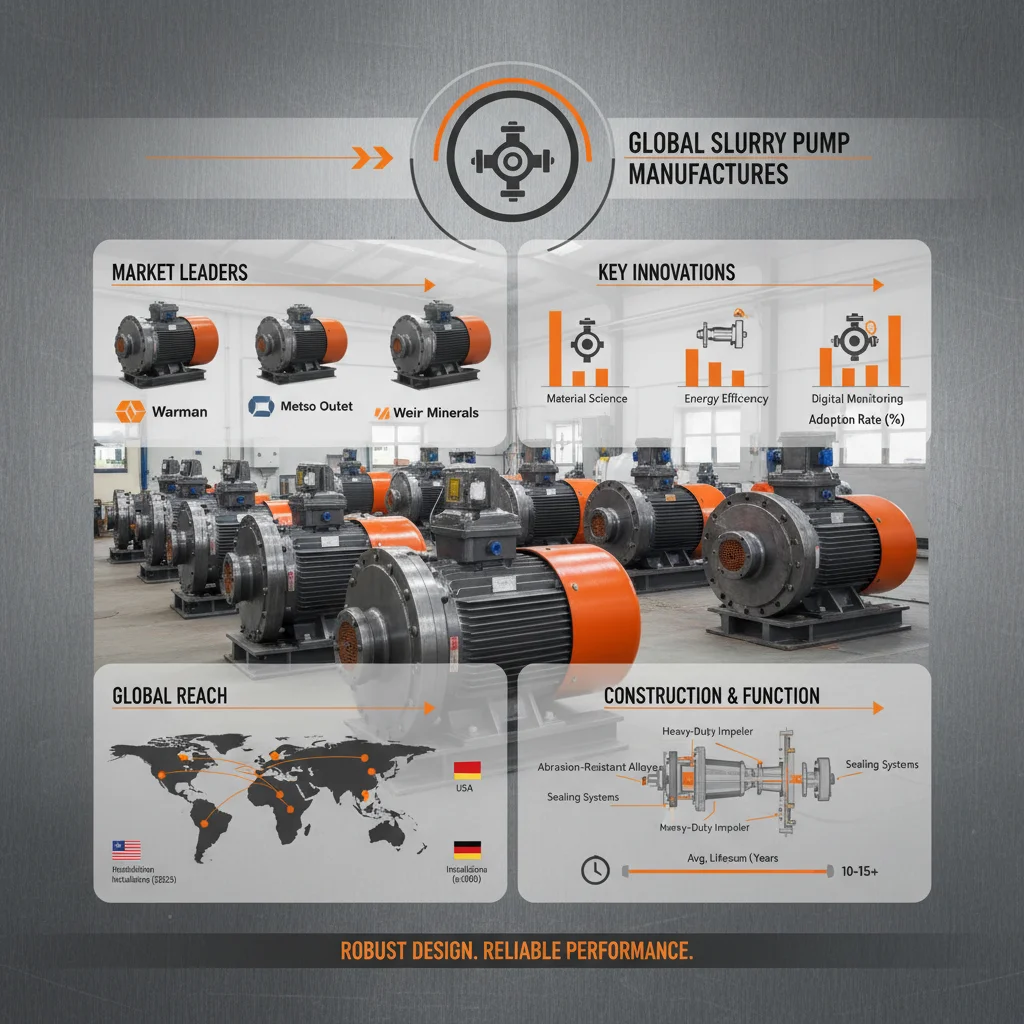
Selecting the right mining slurry pump manufacturers is a critical decision for mining operations where abrasive materials and corrosive fluids can lead to catastrophic equipment failure. In the specialized field of industrial centrifugal slurry pump manufacturing, the ability to balance flow efficiency with material durability determines the overall uptime of a mineral processing plant.
Procurement managers often struggle with the trade-off between initial capital expenditure and long-term operating costs. The primary challenge lies in identifying manufacturers who can provide high-chromium alloy components capable of resisting extreme wear while maintaining hydraulic stability under high-pressure conditions.
This guide provides a professional framework for evaluating supplier capabilities, analyzing technical specifications of gravel and slurry pumps, and understanding the material science required to optimize the total cost of ownership in harsh mining environments.

Evaluating Manufacturer Technical Competence

When vetting mining slurry pump manufacturers, the focus must shift from marketing claims to verifiable production capabilities. A manufacturer's ability to maintain a closed-loop production process—from casting and furan resin sand production to precision machining and final assembly—ensures that structural integrity is not compromised by third-party sourcing.
Hihorn Pump Co., Ltd demonstrates this integration through a facility covering 16,317 square meters, utilizing 1t/3t intermediate frequency induction electric furnaces and a complete range of precision processing equipment, including horizontal and vertical lathes. This infrastructure allows for the strict control of material composition and mechanical properties, ensuring that every pump meets the specific demands of high-density slurry transport.
Material Science in Slurry Transport
The longevity of a slurry pump is fundamentally tied to the Rockwell hardness and chromium content of its wet parts. In applications involving coarse gravel or high-temperature slurries, standard cast iron or low-alloy steels fail rapidly due to erosive wear. High-chromium alloys are the industry standard for mitigating this risk.
For instance, utilizing alloys with a chromium content exceeding 28% and a Rockwell hardness of HRC 66 provides a superior shield against abrasive particles. This level of hardness is essential for reducing maintenance frequency and preventing unplanned downtime in metallurgy, power plants, and the coal industry, where the abrasive nature of the fluid is constant.
Matching Pump Series to Application Needs
Not all slurry applications are identical; therefore, a one-size-fits-all approach to pump selection leads to inefficiency. Manufacturers typically offer a range of specialized series to handle different fluid characteristics, from froth and sump applications to heavy-duty gravel transport.
The HG Series Gravel Pump is specifically engineered for high abrasion and large particle handling, featuring expansive flow passages and large-diameter impellers to prevent clogging. For applications requiring greater lift or pressure, the HGH variant provides a higher head capacity. Other specialized solutions include the HAF Series for froth, HSSP for submersible needs, and HWN for dredging, ensuring the pump's hydraulics match the specific gravity and particle size of the slurry.
Operational Efficiency vs. Wear Life
A critical engineering challenge is the inverse relationship between hydraulic efficiency and wear resistance. High-velocity flow increases throughput but accelerates the erosion of internal components. The goal of advanced hydraulic engineering is to minimize internal turbulence, which reduces localized wear points and extends the service life of the impeller and volute.
The provided conceptual index illustrates the relative impact of design focus on pump performance. By prioritizing low internal turbulence and high-chrome materials, manufacturers can shift the balance toward extended service life without sacrificing the flowrate capacity required for industrial-scale operations.
Critical Selection Parameters for Buyers
When requesting quotes from mining slurry pump manufacturers, buyers must define technical parameters beyond simple flowrate. The discharge diameter (ranging from 100 to 800mm in high-performance series) and the maximum head (up to 90m) are fundamental, but the material specification is where most failures occur.
Evaluating the bearing quality is equally vital. The use of globally recognized brand bearings ensures that the pump can handle heavy mechanical loads and resist corrosion. Additionally, buyers should verify the manufacturer's ability to provide OEM spare parts, as the availability of precision-cast wear parts directly impacts the return on investment (ROI) through reduced lead times for replacements.
Common Pitfalls in Supplier Evaluation
Many procurement teams make the mistake of focusing solely on the purchase price, ignoring the total cost of ownership (TCO). A cheaper pump with lower material hardness (below HRC 60) may require three times as many impeller replacements per year, leading to higher labor costs and lost production revenue.
Another common error is neglecting the importance of traceability. Professional manufacturers implement direct-reading spectrometers and inner hardness testers to ensure 100% traceability of material composition. Without this, there is no guarantee that the alloy delivered matches the technical datasheet, creating a high risk of premature failure in the field.
Manufacturer Performance Framework
To simplify the decision process, the following framework compares standard slurry pump approaches with high-performance gravel pump solutions. This comparison highlights why specialized engineering is necessary for the most demanding mining environments.
| Evaluation Metric | Standard Slurry Pump | HG Series Solution | Operational Impact |
|---|---|---|---|
| Material Hardness | Moderate Alloy | High Chrome HRC 66 | Reduced Wear Rate |
| Particle Handling | Limited Size | Large Gravel/Solids | Prevents Clogging |
| Hydraulic Design | Standard Flow | Low Turbulence | Higher Energy Efficiency |
| Maintenance Cycle | Frequent Replace | Extended Interval | Lower OPEX |
| Thermal Stability | Standard Temp | High Temp Ready | Process Flexibility |
| Total Cost (TCO) | High Long-term | Optimized ROI | Maximum Profitability |
This framework demonstrates that while the initial investment in high-specification pumps may be higher, the reduction in maintenance frequency and energy consumption provides a significantly lower total cost of ownership over the equipment's lifecycle.
Frequently Asked Questions
The HG series is designed for standard high-abrasion slurry transport. The HGH series is specifically engineered for higher head demands, making it the correct choice for applications requiring greater lift or higher discharge pressure.
A Rockwell hardness of HRC 66, achieved through high chromium alloy (over 28% Cr), provides extreme resistance to abrasive particles, significantly extending the wear life of wet parts compared to standard industrial alloys.
Yes, the HG series is specifically engineered to maintain structural integrity and performance levels even when transporting high-temperature slurries, making them suitable for specific metallurgical and chemical processes.
Prevention is achieved through the integration of large-diameter impellers and wide flow passages, which allow coarse gravel and heavy solids to pass through the system with minimal resistance.
High-performance gravel pumps can handle flowrates ranging from 80 to 10,000 m³/h and can reach a maximum head of up to 90 meters, depending on the specific model and configuration selected.
Furan resin sand production allows for high-precision casting of complex pump geometries. This ensures the internal hydraulics are accurate, reducing turbulence and improving the overall efficiency of the pump.
Conclusion
Optimizing slurry transport requires a strategic partnership with mining slurry pump manufacturers who prioritize material science and hydraulic precision over low-cost production. By focusing on high-chromium alloys with HRC 66 hardness and low-turbulence designs, mining operations can drastically reduce their maintenance cycles and improve long-term ROI.
For organizations evaluating their fluid delivery solutions or seeking high-reliability spare parts, detailed technical specifications and application analysis are available at www.hihornpump.com to ensure a precise match between equipment capability and operational demand.